La Cachucha – Spanish dances in ballets
The ‘Cachucha’ refers to a small boat and the lyrics of these dance songs almost all refer to a small boat. They originated when Cadiz defended itself against Napoleon’s troops in the period 1810-1812. It is mainly a patriotic song, danced very fast, accompanied by guitar, tambourine and castanets.
This popular dance spreads throughout Andalusia and finds its way to the dance stages the all over the world:
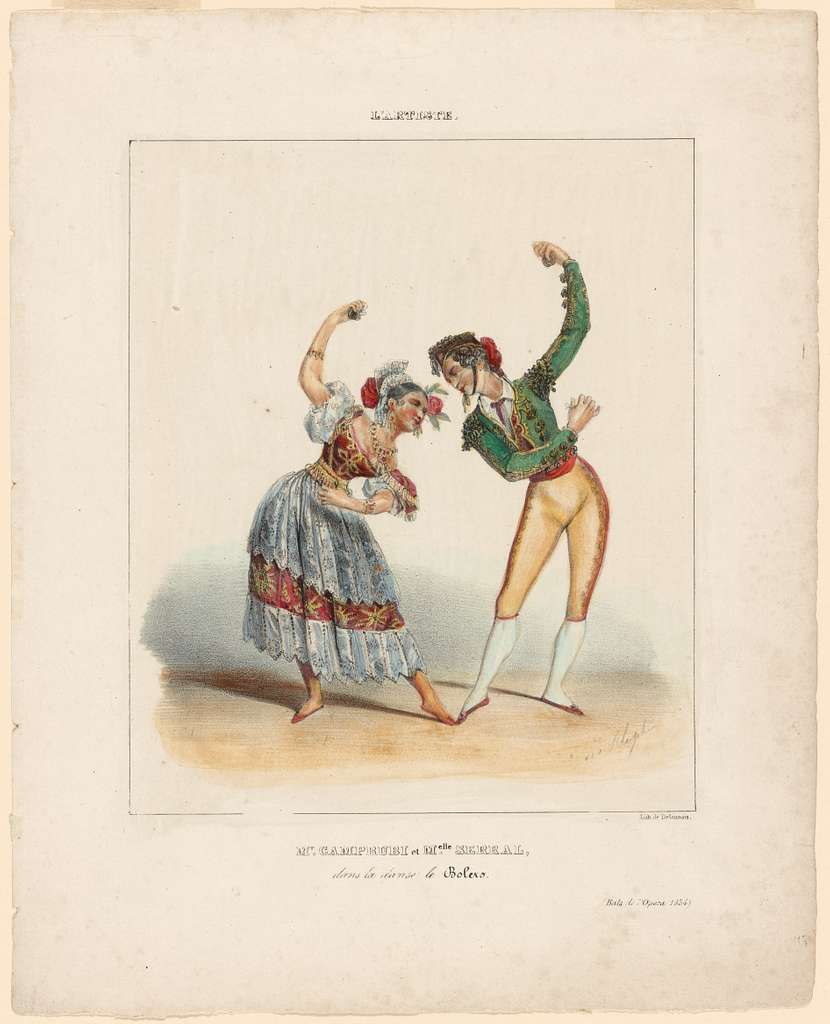
The Spanish stage dancers, the ‘bolero dancers’, become aware of the them. The first Spanish stage dancers to dance the cachucha in the bolero style were probably: Dolores Serral (1816-1885) and Mariano Camprubí (XIII-XIX century). They also danced the Cachucha in 1834 at the Paris Opera. And now the ballet world takes notice.
It is the era of Romantic ballet, with ballerinas portraying spirit beings, sylphs, fairies and willies, and pointe work becoming established to convey the impression of the dancers gliding through the air. But so-called national and character dances from Russia, Poland, Hungary, Italy and Spain also find their way onto the ballet stage. This important phase in ballet history, the Romantic Ballet, lasts only 10 years from 1831 to 1841.
The renowned dancer and ballet teacher Carlo Blasis (1797–1878), director of the Milan Scala dance academy from 1837, also describes the cachucha in his book ‘Complete Handbook of Dance’, written around 1830.
One of the leading ballerinas of the time, Fanny Elssler (1810-1884), danced the Cachucha with castanets as a solo version in 1836 and enjoyed overwhelming success with it. She performed it in Washington in 1840 and in London, Vienna, Berlin, Brussels, Budapest, Saint Petersburg, Moscow and Naples. Her success set a precedent, and Spanish stage dance with castanets found its way into ballet productions.
From 1850 onwards, the popularity of the cachucha declined in Spain, but it continued to be part of the repertoire of the so-called bolero school that developed in the late 19th and early 20th centuries under the name ‘Boleras de la Cachucha’.
In Granada, it becomes part of the Zambras del Sacromonte with the name ‘El perdón de la novia’ (Boda gitana).