This still very popular couple dance from Seville originated from the seguidillas (coplas de la seguida). For centuries, the seguidillas were the most popular dance songs and the prototype of joyous dance, passionate, very sensual and rustic. They were accompanied by castanets and foot rhythms – “taconéo”, danced with graceful, airy movements and quick beats with the heel and toe.
Originating in La Mancha in the 15th century, they spread throughout Spain. In the first half of the 17th century, they appeared on the theatre stages of the “Cómicos” and continued to feature in the interludes – the “Tonadillas” – well into the 18th century.
They served as an archive and inspiration for the development of new dances and also formed the basis for the development of the bolero and bolero dances.
Incidentally, the so-called ‘escuela bolera’ was created and developed by Ángel Pericet (1877-1944) at the end of the 19th and beginning of the 20th centuries, from the “bailes boleros”, “bailes andaluces”, “bailes de palillos” (bolero dances, Andalusian dances, castanet dances) of the 18th and 19th centuries, with a strong influence from classical ballet, which gave it a modified ‘classical’ style. The Pericet family then developed and cultivated the highly stylised Escuela Bolera.
Back to the Sevillanas: In Andalusia, the Seguidillas gave rise to the Seguidillas Sevillanas, later simply called Sevillanas. There were and still are a very large number of variations in all keys also used in flamenco: major, minor and the flamenco key (modo flamenco – Phrygian), with very variable introductions and melodies, but always the same structure of the verses and the respective ‘bienparao’, the final pose, of the dancers.
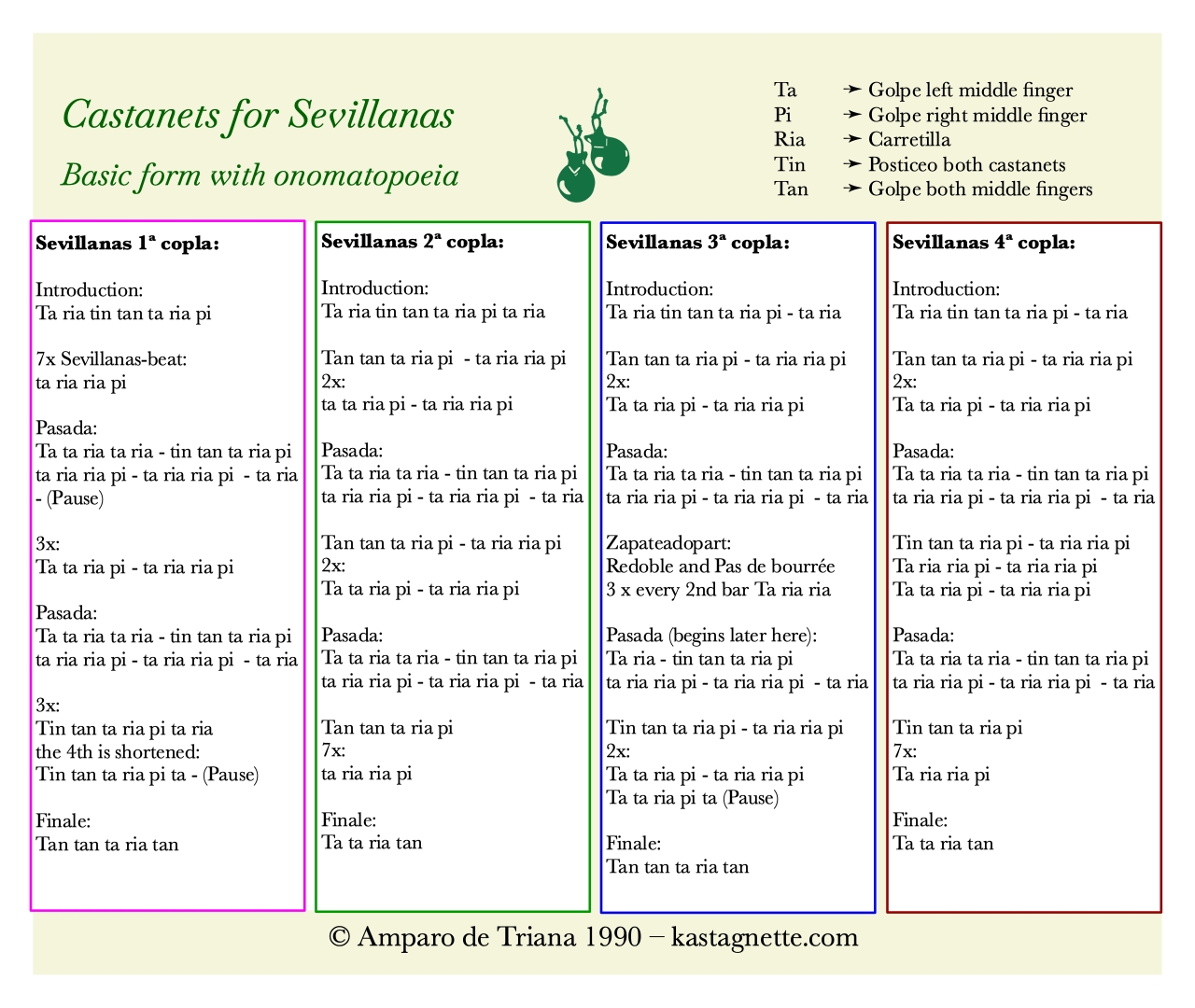
And here is a traditional castanet part for it, once as a sheet of music and once with the usual onomatopoeia. The prelude and the interludes of the music are, as written above, very different in style and length. It is a three-count bar, a 3/4 bar, but in dance one likes to count 2 bars as one, so 6 counts, or 6/4 time. So you have to listen out when the dance begins. When counting the 3/4 beat, the castanet part starts on the 1 and the first step on 2. When counting the 6/4 beat, the castanet part starts on 4 and the first dance step on 5.