How do I write down different carretillas in a castanet bigram? This blog already shows an introductory article on article on the castanet bigram including various explanations. I shall build here on that basis. If You are unsure, You will be able to read up on the basics there.
I begin a carretilla with a pulse beat starting from the little finger and then sliding each of the four fingers of one hand over the castanet in succession, applying pressure to produce a beat with each subsequent finger. To make it clear that this is a so-called ‘carretilla resbalada’, I use slurs, or ‘legato arcs’, in the notation.
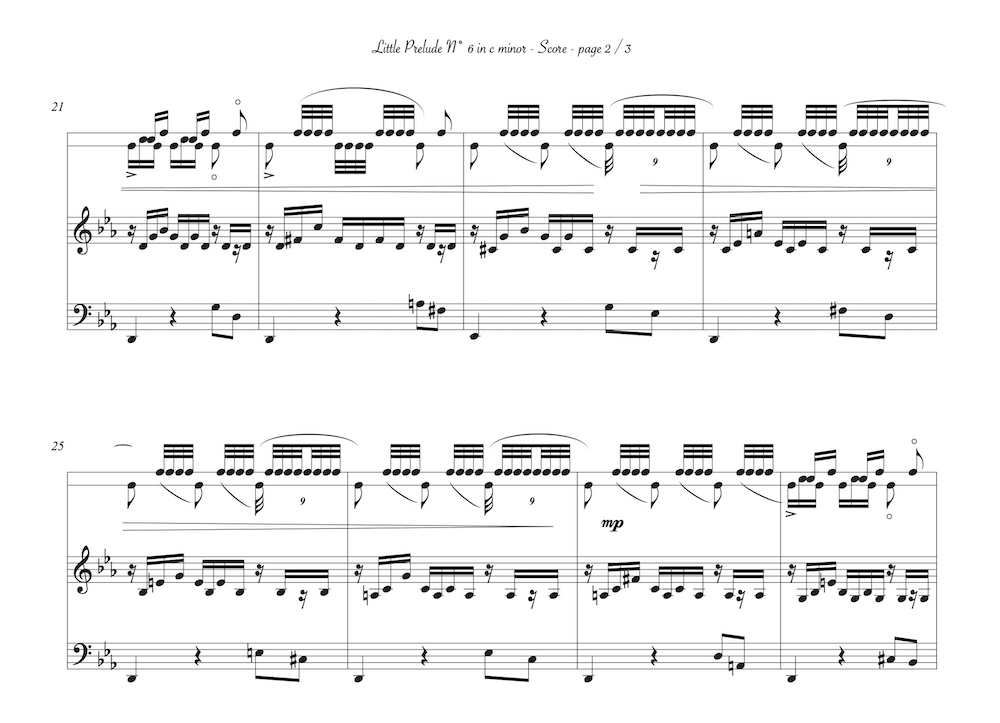
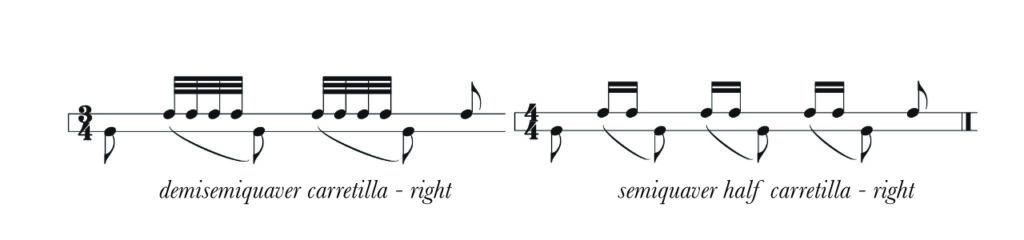
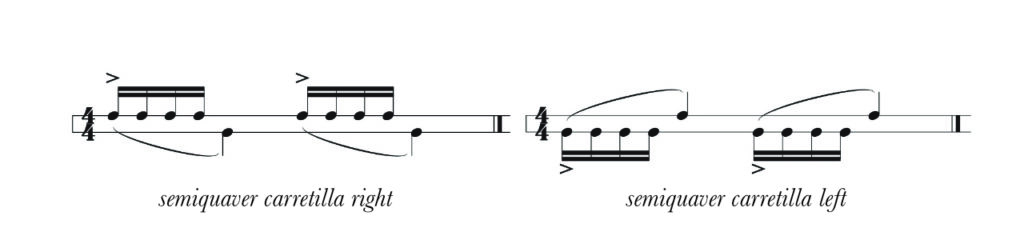
In this example of a normal demisemiquaver carretilla, the slur runs from the beat of the little finger of the right hand to the beat of the left middle finger. The slur runs below, i.e. across the lower staff line. The same applies to a half carretilla, which is played with fingers 3 and 4.
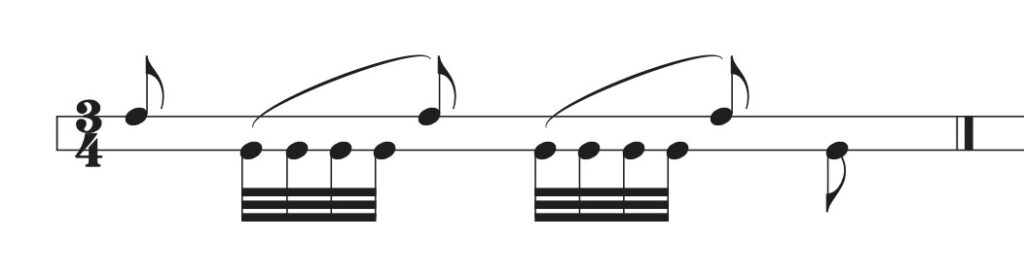
Here is an example of when a carretilla is to be performed with the left hand. Here, the slur runs above, i.e. across the upper staff line.
Variations in different note values follow.
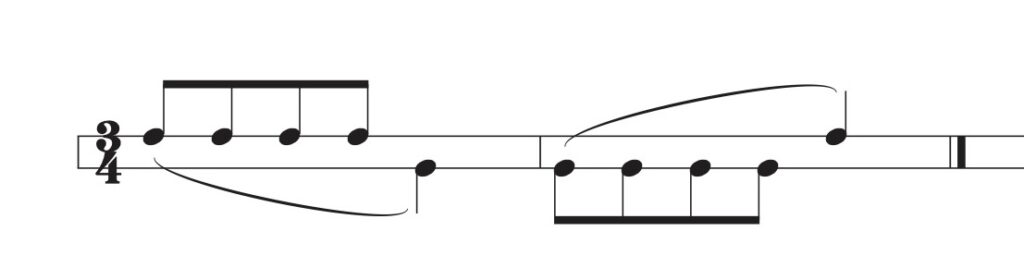
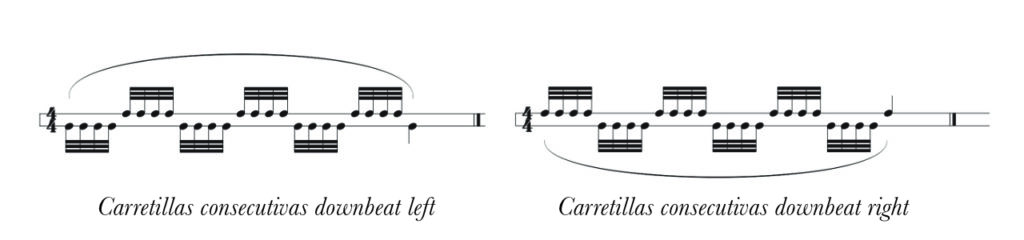
So-called ‘carretillas consecutivas’ – i.e. without a downbeat of the middle fingers – are given a slur over their entire duration, i.e. from the first beat of the little finger of one hand to the downbeat. If the downbeat is played with the left hand, the slur is above it; if it is played with the right hand, it is below it, i.e. outside the stave. This is very helpful when sight-reading the notes.
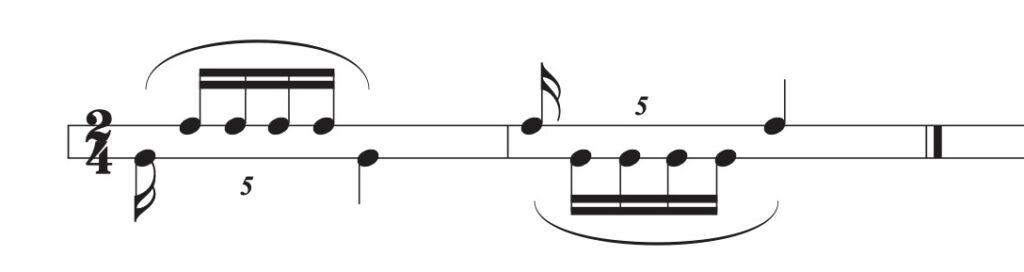
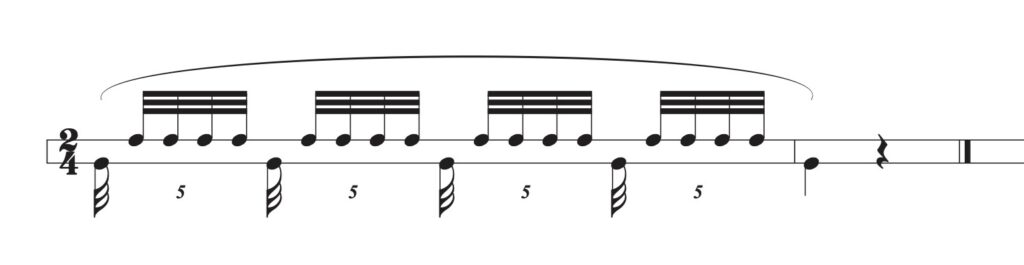
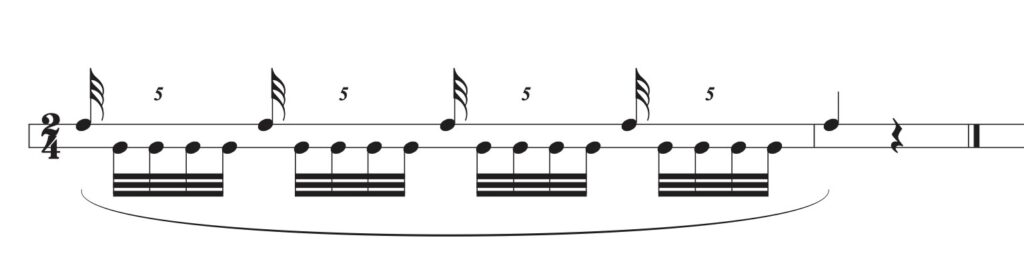
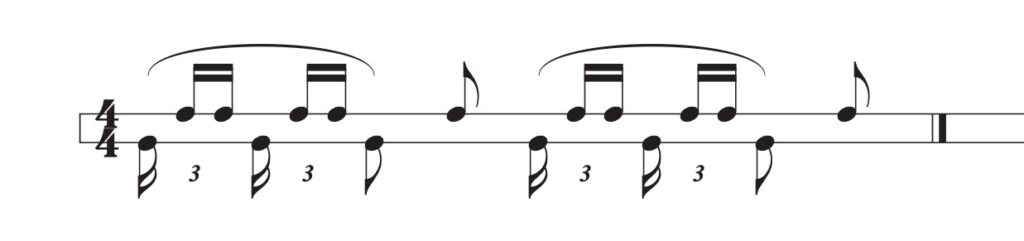
And now to the ‘quintuplets’: A quintuplet begins on the upbeat of the middle finger of one hand, followed by the four beats of the fingers of the other hand. All beats must be equally spaced, for example five semiquaver notes in the same period as four semiquaver notes evenly distributed. The downbeat follows on the first hand. Here, the upbeat is connected to the downbeat by a slur. The ‘carretilla seguida’, a series of successive quintuplets, is connected by a single slur. Here, too, if the downbeat is played with the left hand, the slur is above it; if it is played with the right hand, the slur is below it. The same applies to half carretillas, which are played as triplets with the fingers 3 and 4
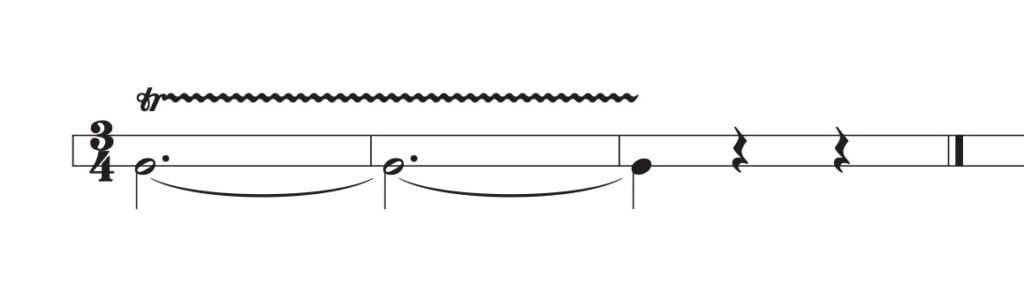
And the ‘trills’? These are quite easy to notate with the trill symbol in the musical notation. It is important to note that if the trill is to be longer, i.e. over several notes and possibly also over several bar lines, an additional held bow, a so-called ‘ligature’, must be used. The ligature connects notes that are on the same staff line. In singing, the note would be held for the corresponding length of time.
There are many other variations of carretillas, but the rules for notation apply here, too.
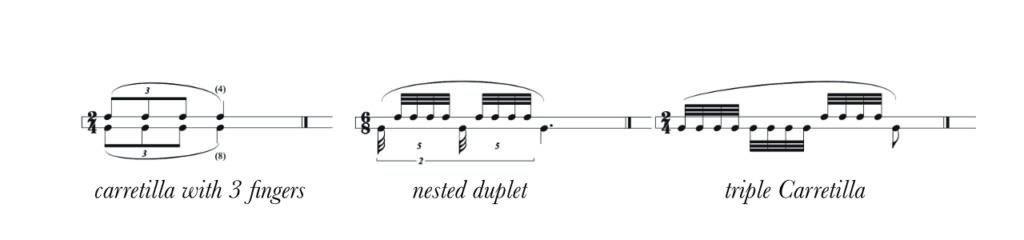
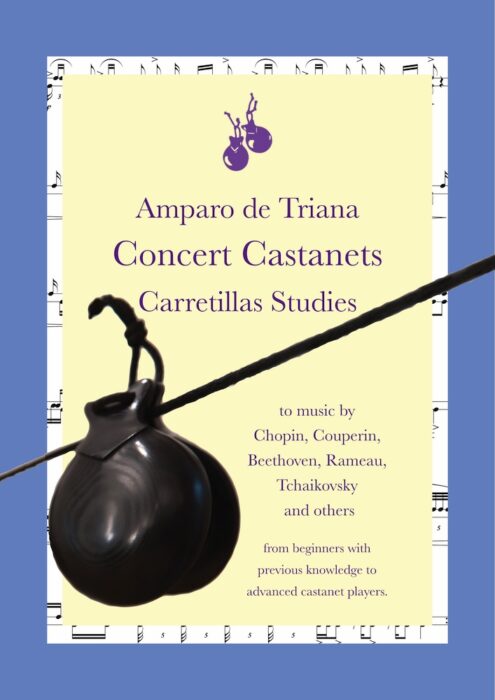
In my sheet music book Concert Castanets Carretillas, You will find a detailed introduction to the topic of carretillas in the foreword. A total of 20 études will enable You to thoroughly study and deepen your knowledge of the various forms of carretillas.